Types of AI Agents Explained (and Where Memory Fits Into Each One)
Ask five different people to define "AI agent" and you'll likely get five different answers. Some mean a chatbot that can call an API. Others mean a fully autonomous system managing a multi-step business process. Both are technically right, and that's exactly the problem. The term has stretched to cover such a wide range of systems that using it without qualification doesn't tell anyone much about what you're actually building or evaluating.
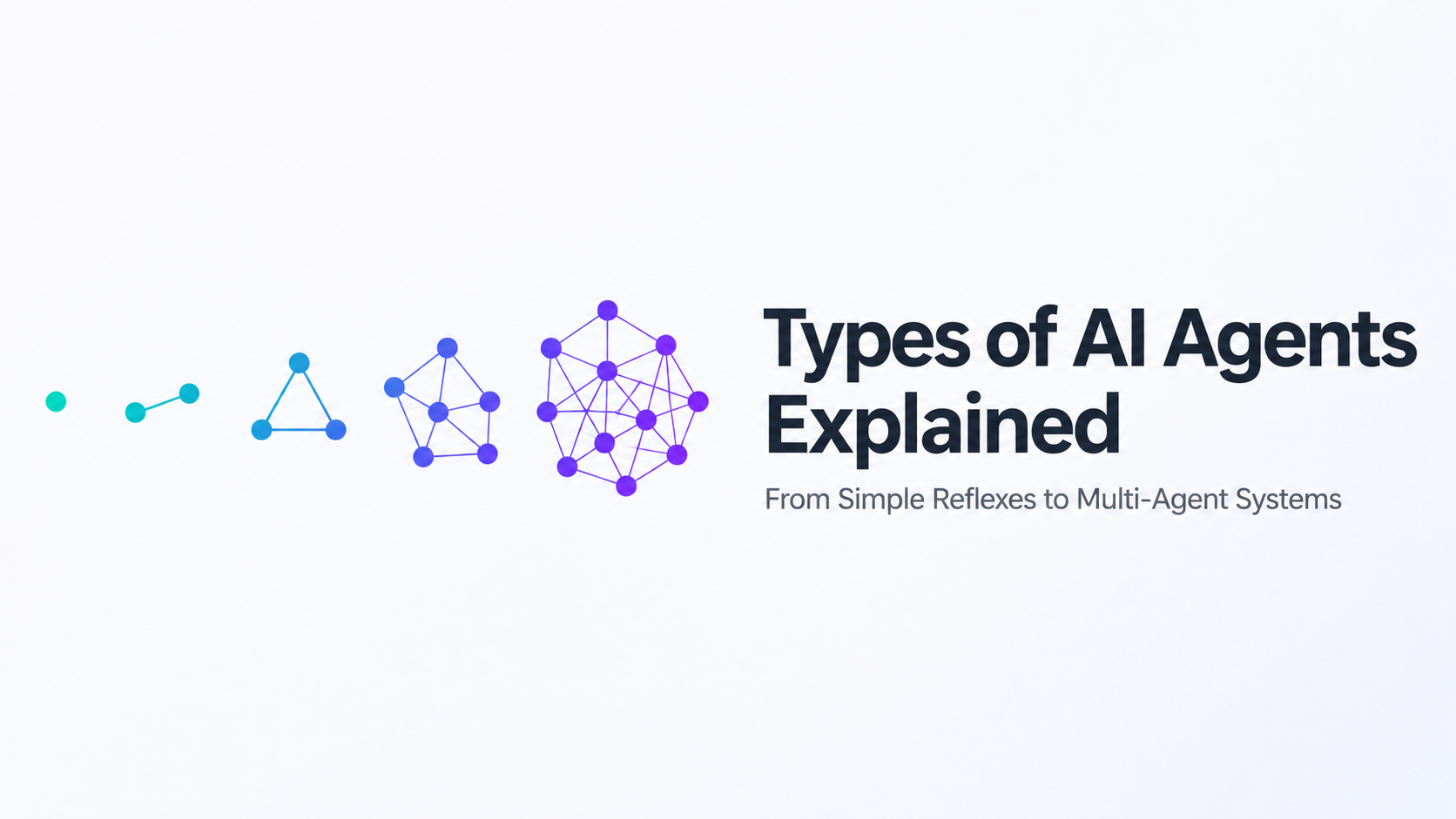
A more useful way to think about this is by type, since AI agents aren't one category of thing. They're a spectrum, ranging from simple, rule-bound responders to complex, self-directed systems that plan and adapt on their own. Each type solves a different problem, needs a different amount of engineering effort, and, importantly, needs a different kind of memory to actually work well. Understanding where a given system sits on this spectrum tells you far more than the word "agent" ever will on its own.
Simple reflex agents
At the most basic end of the spectrum are simple reflex agents. These systems respond directly to a current input based on a fixed rule or condition, with no consideration of anything beyond the immediate situation. If input matches condition A, take action B. That's the whole logic.
A basic customer support bot that responds to specific keywords with a canned answer is a simple reflex agent. So is a spam filter flagging an email based on fixed criteria. These systems are fast, predictable, and easy to build, and they genuinely work well for narrow, well-defined problems where the input space is limited and predictable.
Memory needs: essentially none. A simple reflex agent doesn't need to remember anything from a past interaction, because its entire behavior is determined by the current input alone. This is the one category on this list where skipping memory entirely is often the correct engineering decision, not a limitation.
Model-based reflex agents
A step up from simple reflex agents, model-based reflex agents maintain an internal representation of the world that isn't directly observable from the current input alone. They track some state, what's happened recently, what the current context implies, and use that internal model to decide on an action, rather than reacting to raw input in isolation.
A thermostat that adjusts heating based on both the current temperature and a model of how the room tends to lose heat over time is a simple physical example. In software, a customer support agent that tracks the current conversation's context, not just the single latest message, to give a coherent multi-turn response, fits this category.
Memory needs: short-term, session-scoped memory. This category needs to remember what's happened within the current interaction to maintain a coherent internal model, but it typically doesn't need to persist that state across sessions. Once the conversation ends, the model resets.
Goal-based agents
Goal-based agents introduce something the earlier categories don't have: a defined objective the system is actively working toward, and the ability to evaluate different possible actions based on whether they move toward that goal. Instead of just reacting to the current state, a goal-based agent reasons about which action, among several options, actually gets it closer to a specified outcome.
A booking agent that needs to find a flight matching several constraints, budget, timing, layover preferences, and evaluates multiple options against that combined goal before picking one, is a goal-based agent. Rather than simply responding to input, it actively searches for the action that best satisfies a stated objective.
Memory needs: working memory for the current goal and constraints, plus increasingly, memory of what's worked or failed in similar situations before. A booking agent that remembers a user consistently prefers morning flights, even when they didn't explicitly restate that preference this time, is meaningfully more useful than one that treats every request as a blank slate.
Utility-based agents
Utility-based agents go a step further than goal-based ones. Rather than just checking whether an action satisfies a goal, they weigh multiple possible outcomes against each other using a utility function, essentially a way of scoring how good or desirable each outcome actually is, not just whether it technically qualifies.
This matters when there's more than one way to satisfy a goal and the options aren't equally good. A logistics agent choosing a delivery route isn't just looking for any route that arrives on time, it's weighing cost, speed, and reliability against each other to find the best balance, not merely an acceptable one.
Memory needs: similar to goal-based agents, but with an added need to remember outcomes over time to refine what "good" actually means in practice. A utility-based agent that tracks whether its past choices actually turned out well, not just whether they technically met the goal at the time, can improve its own utility function based on real outcomes rather than static assumptions.
Learning agents
Learning agents add a feedback loop the earlier categories lack entirely: the ability to improve their own performance over time based on experience, rather than operating from fixed logic that a human defined upfront and never revisits.
A recommendation system that adjusts its suggestions based on which past recommendations a user actually engaged with is a learning agent. So is a fraud detection system that refines its flagging criteria based on which past flags turned out to be correct versus false positives.
Memory needs: this is where memory stops being optional and becomes the entire mechanism the system depends on. A learning agent without persistent memory of past outcomes isn't learning anything, it's just running the same static logic repeatedly. The memory here needs to be structured enough to distinguish what actually worked from what didn't, not just a raw log of everything that happened.
Multi-agent systems and agentic AI
The most complex category isn't really a single agent type at all, it's a coordination layer, often what people mean when they say "agentic AI" specifically. Multiple agents, sometimes of different types from the categories above, work together under some orchestration logic to handle a broader goal than any single agent could manage alone. One agent might handle research, another drafts a response, another checks the output against a set of rules, and a coordinating layer decides how they work together and adjusts the plan based on what's coming back from each one.
This is genuinely the most capable category, and also the one that depends most heavily on shared, well-structured memory to function at all. Without it, coordination between agents falls apart, since each agent effectively has to be told everything relevant from scratch every time it's invoked, which defeats much of the point of having multiple specialized agents working together in the first place.
Memory needs: persistent, structured, and shared across the system. Working memory for the current task, episodic memory of what's been tried and what happened, and semantic memory of standing facts and preferences that every agent in the system should have access to, not siloed separately per agent. This is the category where the distinction between a good memory architecture and a mediocre one shows up most visibly in whether the whole system actually works or just looks impressive in a demo.
How to identify which type you're actually dealing with
Since vendors rarely label their systems by these categories directly, it helps to have a few concrete questions ready when evaluating a platform or scoping a build.
Does the system's behavior change based on anything beyond the current input? If not, it's a simple reflex agent, which is fine for narrow tasks but shouldn't be marketed or budgeted for as anything more sophisticated.
Does it maintain context within a session but reset between sessions? That's a model-based reflex agent, useful for coherent conversations but not for anything requiring the system to remember a user across visits.
Is it actively evaluating multiple possible actions against a stated objective, rather than just following a fixed rule? That pushes it into goal-based or utility-based territory, and it's worth asking specifically whether it's just checking a box (goal-based) or actually weighing tradeoffs between options (utility-based), since vendors sometimes use these terms loosely.
Does its behavior actually improve over time based on real outcomes, or does it perform identically today as it did on day one regardless of how much it's been used? If nothing changes, it's not a learning agent no matter what the marketing says. Genuine learning agents should be able to point to a concrete mechanism, what gets tracked, what gets fed back into future decisions, not just a vague claim of getting smarter.
Is it coordinating multiple distinct agents or tools toward a broader goal, adjusting the plan based on intermediate results? That's the multi-agent, agentic AI category, and it's worth specifically asking how memory is shared across the agents involved, since this is where systems most often look impressive in a sales demo and fall apart under real, messier conditions.
None of these categories are inherently better than the others in the abstract. A simple reflex agent that does one narrow job reliably is a better engineering choice than an over-engineered multi-agent system for a task that never needed that complexity. The goal isn't to build the most sophisticated agent possible, it's to match the type of system, and its memory architecture, to what the actual problem requires.
Here's the practical point underneath all of this. When you're evaluating a platform, or deciding what to actually build, the useful question isn't "is this an AI agent." Almost everything gets called that now. The useful question is where on this spectrum the system actually sits, and whether its memory architecture matches what that position actually requires.
A simple reflex agent doesn't need a sophisticated memory system, and building one for it is wasted engineering effort. A multi-agent orchestration system without real persistent memory isn't actually agentic in any meaningful sense, no matter what the marketing page says, it's a collection of narrow agents with no way to build on what's already happened. Mismatches in either direction are where a lot of real-world AI projects quietly underdeliver relative to what was promised.
Where this connects to memory infrastructure
This is exactly why memory can't be treated as a single, one-size-fits-all feature bolted onto any agent regardless of type. The further up this spectrum a system sits, goal-based, utility-based, learning, or multi-agent, the more its actual usefulness depends on memory that's structured correctly, not just present.
Contivon is built around this distinction directly, providing memory that scales in sophistication with what the agent actually needs, from short-term working context up through persistent, structured, shared memory for coordinated multi-agent systems. Paired with Atlas, our reasoning engine, agents get both the right kind of memory for their position on this spectrum and the reasoning capability to actually use it well.
The bottom line
"AI agent" alone doesn't tell you much anymore. The real distinctions, reflex, goal-based, utility-based, learning, or multi-agent, tell you what a system can actually do, and just as importantly, what kind of memory it needs to do it well. Getting that match right is a bigger factor in whether an AI system actually works in production than almost anything else in how it's built.
Want to see memory infrastructure built for exactly this spectrum? Explore Contivon and Atlas at prolixislabs.com .