What Is LangGraph? A Guide to Stateful AI Agent Orchestration and Where Memory Fits In
If you've spent any time building multi-step AI agents recently, you've likely run into LangGraph. It's become one of the default frameworks for building agents that do more than answer a single prompt, ones that reason across multiple steps, call tools, loop back to reconsider earlier decisions, and coordinate with other agents. It's part of the LangChain ecosystem, and it's grown fast enough to become a genuine standard rather than just one option among many.
Here's what LangGraph actually does, how it handles state, and, importantly, where it stops, because understanding that boundary matters a lot if you're deciding what else you need alongside it.
What LangGraph actually is
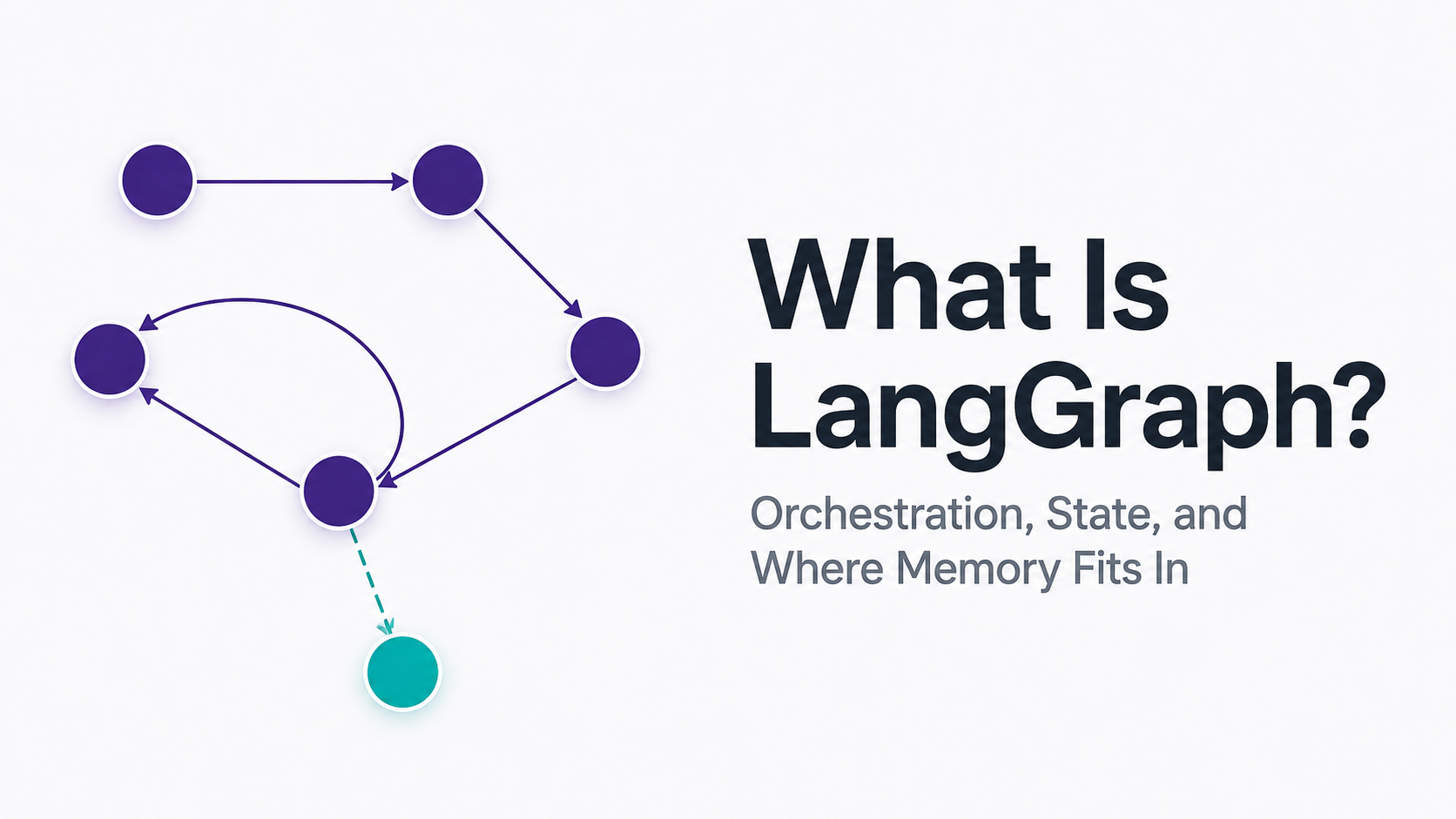
At its core, LangGraph is a framework for modeling an AI agent's workflow as a graph rather than a straight line. Traditional prompt-response chains run in one direction: input goes in, output comes out, done. LangGraph replaces that with nodes and edges. Each node represents a step, an LLM call, a tool invocation, a calculation, and edges define how execution flows between them, including conditionally, based on what happened in a previous step.
This graph structure unlocks something a simple linear chain can't do well: cycles. An agent built with LangGraph can loop back to an earlier node to retry something, refine an answer, or reconsider a decision based on new information, rather than being locked into a single forward pass. This is genuinely useful for the kind of iterative reasoning real tasks require, since very few complex problems get solved correctly on the first attempt.
LangGraph also supports native human-in-the-loop control. A conditional edge can route execution to an interrupt node, pausing the entire workflow until a person reviews or modifies what happens next. This is built directly into the framework rather than something developers have to bolt on separately, and it's become a common way teams implement approval steps and safety checks in production agent workflows.
How LangGraph handles state
The central concept that makes all of this work is the StateGraph, an object that maintains the agent's shared state as it moves through the graph. Every node can read from and write to this shared state, and every update gets checkpointed automatically. This solves a real, practical problem that predates LangGraph: manually passing context through function arguments between steps, and losing pieces of it along the way, which used to be a common source of bugs in earlier agent-building approaches.
For local development, a simple in-memory checkpointer works fine. For anything running in production with real concurrency, a persistent backend like Postgres is generally the recommended approach, since lighter-weight options tend to become a performance bottleneck under real load. This checkpointing is also what enables pause-and-resume functionality for long-running tasks, an agent can stop partway through a complex workflow and pick back up exactly where it left off, rather than needing to restart from the beginning.
This is a genuinely well-designed piece of infrastructure, and it's a big part of why LangGraph has grown as fast as it has. As of recent counts, it's accumulated well over 100,000 stars on GitHub, and it's under active, frequent development with new releases shipping regularly.
The distinction that matters most: state versus memory
Here's the part that gets glossed over in a lot of introductory guides, and it's the most important thing to understand if you're evaluating LangGraph for a real project.
What LangGraph manages natively is state within a single run, sometimes called a thread. It checkpoints where an agent is in a given task, what's happened so far in that specific execution, and lets the workflow pause and resume within that scope. This is extremely useful, and it functions well as a kind of working memory for the duration of one task or conversation.
It is not, on its own, the same thing as persistent memory that carries meaningfully across sessions over time. When a thread ends, the state associated with it doesn't automatically become something a future, unrelated session can draw on the way a human assistant would recall a past conversation with you. Teams building genuinely long-lived, personalized agents run into this gap quickly: a customer support agent that needs to remember a user's preferences from three weeks ago, or an internal tool that should recall a decision made in an earlier project, needs something beyond thread-scoped checkpointing to do that well.
This has become well understood enough in the developer community that a fairly standard pattern has emerged. Agent state management now tends to split into two distinct layers: LangGraph handling thread-scoped checkpointing on one side, and a separate, dedicated memory system handling cross-session, persistent memory on the other. Tools like Mem0 and Letta have become common choices for that second layer specifically because LangGraph's built-in state, however well built, wasn't designed to solve that particular problem.
Why this split makes sense architecturally
It's worth understanding why this two-layer pattern exists rather than treating it as a limitation to work around. Thread-scoped state and long-term memory are genuinely different problems with different requirements.
Thread state needs to be fast, tightly coupled to the specific execution flow, and automatically checkpointed at every step without the developer thinking about it much. It's optimized for reliability within a bounded task.
Long-term memory needs something different: the ability to decide what's actually worth retaining once a task is finished, structure that information so it can be retrieved accurately much later, handle facts that might contradict or supersede earlier ones, and scope what gets shared across different users, sessions, or agents appropriately. That's a different kind of system, closer to a knowledge base than a workflow checkpoint, and trying to force one system to do both jobs well tends to produce something that's mediocre at each.
Teams that try to skip this distinction, treating LangGraph's thread state as if it were full long-term memory, tend to hit the same wall eventually: the agent works great within a session and forgets everything that mattered the moment that session ends, which defeats a large part of what makes a genuinely useful, personalized agent valuable in the first place.
A concrete example of where the gap shows up
It helps to see this play out rather than just describe it abstractly. Say a team builds a client onboarding agent using LangGraph. The graph handles the workflow well: collect company details, verify documents, route to the right internal team, checkpoint progress so the process can pause and resume if a document is missing. Within a single onboarding session, this works exactly as intended, state flows cleanly between nodes, and if something interrupts the process, it picks back up right where it left off.
Three months later, the same client comes back with a follow-up request. A well-designed agent should recall the company's earlier onboarding details, the preferences they stated, the specific technical setup that was already discussed, without asking the client to repeat all of it. But that original onboarding thread has long since ended. Its checkpointed state isn't something the new session automatically has access to, because thread-scoped state was never designed to function as a permanent record the way a dedicated memory system is.
This is exactly the moment teams realize they need a second layer. LangGraph did exactly what it was built to do. The actual product requirement, an agent that remembers a client across separate interactions over time, was always a different problem than orchestrating a single workflow correctly.
Common mistakes teams make with LangGraph and memory
A few patterns show up repeatedly among teams working through this.
Assuming a longer checkpoint retention period solves the problem. Keeping thread state around longer doesn't turn it into structured, retrievable long-term memory, it just means old, unstructured session data sits around longer without becoming more useful. The issue isn't retention duration, it's that thread state isn't organized or scored for relevance the way a real memory system needs to be.
Building custom memory logic from scratch inside the graph itself. It's tempting to add a node that writes summaries to a database and call that memory. This can work at a small scale, but it tends to become an unmaintained, ad hoc system that doesn't handle contradiction resolution, relevance scoring, or scoping across users well, essentially reinventing a dedicated memory layer poorly instead of using one built for the purpose.
Treating memory as an afterthought rather than an architecture decision made early. Retrofitting persistent memory into an agent that was built assuming session state was enough tends to require real rework, since prompts, retrieval logic, and workflow structure often need to change to actually take advantage of memory once it's added. Planning for it from the start, even if the first version doesn't need it yet, tends to save significant effort later.
If you're building on LangGraph and you've hit this exact gap, a few things matter when evaluating what to pair it with.
It should integrate cleanly with LangGraph's existing state model rather than requiring you to rebuild your orchestration logic around it. It should let you retrieve only what's relevant to the current context rather than dumping everything a user has ever said back into the prompt, since that reintroduces the context bloat problem that a good architecture is trying to avoid in the first place. And it should be attributable and structured, letting you trace where a given memory came from and understand why it's being surfaced, rather than functioning as an opaque black box that occasionally returns something useful and occasionally doesn't.
This is precisely the layer Contivon is built to provide. Rather than treating memory as an extension of session state, Contivon gives LangGraph-based agents, and agents built on other orchestration frameworks, a genuine persistent memory layer: structured, attributable, and retrieved based on relevance rather than accumulated indiscriminately. It's built to sit alongside orchestration frameworks like LangGraph, not replace what they already do well. Paired with Atlas, our reasoning engine, agents get both solid thread-level orchestration and the kind of long-term memory that actually makes an agent feel like it remembers you, not just the current task.
When you need LangGraph alone versus LangGraph plus a memory layer
If you're building something genuinely single-session, a research assistant that runs once and produces a report, a data pipeline agent that processes a batch and finishes, LangGraph's built-in state management is likely sufficient on its own. There's no meaningful benefit to adding a separate memory layer for something that has no real concept of "returning users" or "past context that should carry forward."
If you're building anything with repeat interactions over time, a customer-facing assistant, an internal tool used by the same team daily, an agent meant to get more useful the longer it's used, you'll hit the limits of thread-scoped state fairly quickly, and it's worth planning for a dedicated memory layer from the start rather than retrofitting one in after users start noticing the agent forgets them.
The bottom line
LangGraph solves a real and important problem well: orchestrating complex, multi-step, stateful agent workflows with proper checkpointing, cyclical reasoning, and human-in-the-loop control. What it doesn't solve, by design rather than by oversight, is long-term memory that persists meaningfully across sessions. Understanding that boundary early saves a lot of rework later, and the two-layer pattern that's emerged in the developer community, orchestration on one side, dedicated memory on the other, reflects that these are genuinely different problems worth solving separately and well.
Want to see how a dedicated memory layer pairs with orchestration frameworks like LangGraph? Explore Contivon and Atlas at prolixislabs.com .